
Andover City Directory Holdings by Year
The Minnesota Historical Society describes this Andover run as part of its Anoka County telephone-directory collection rather than a confirmed Polk series. White-page material for Andover spans 1978 through 2005. A 2011-2012 Yellow Pages volume completes the holdings. Formats alternate between selected print and microfiche. Each book supplies a subscriber name, telephone number, and street address for the year printed, which is exactly what a street directory does best. It cannot establish every person in an Andover household, nor does it prove a present-day address.
| Collection | Years | Where held | Access |
|---|---|---|---|
| Andover telephone directories | 1978-2005; 2011-2012 Yellow Pages | Minnesota Historical Society finding aid, print and microfiche rows | Open for research; holdings are incomplete |
| Anoka County telephone-directory inventory | 1916 onward across many communities | Minnesota Historical Society, catalog ID 001668157 | Open research collection; Andover rows begin later |
| Anoka County Union | 1865-2002 | Anoka County History Center microfilm | On-site newspaper and obituary trail |
| Anoka Herald | 1885-1960 | Anoka County History Center microfilm | On-site historical and family notices |
| Anoka County census material | 1857-1920 | Anoka County History Center | On-site township and residence context |
The finding aid pins down shelf details for the earliest Andover rows: 1978 print sits at shelf 2195, 1979 print at shelves 238 and 2196, and 1980 print at shelf 2198. Later entries mix print, fiche, and Yellow Pages. The format matters. It shapes how you arrange an Andover research visit or request staff help, since the holding is not one uninterrupted run. No official digitized Andover volume exists. The finding aid also lists no individual local publisher imprint for each Andover row, so attribution stays at the collection level.
Andover Directory Formats and Gaps
Andover white pages and Yellow Pages answer different questions. White pages list residential and business telephone subscribers alphabetically. Yellow Pages sort businesses by subject. A telephone listing is a lead about a subscriber at a historical address. It is not a household census. MNHS says family listings usually name the head of household. Minors rarely appear. Women generally show up only when living independently, whether single, widowed, or divorced.
Keep the gaps visible in your research notes. No continuous volume covers every year. A missing name can reflect a missing holding. It can also reflect no phone subscription, a recent move, an unlisted number, or the directory's own convention. No criss-cross or reverse title appears in the holdings. A physical white-page volume may still carry an Andover street section. Check the print books before counting on that feature.
See the Minnesota Historical Society finding aid for Anoka County telephone directories before choosing an Andover year. Format matters too. The inventory page displays the shelf and format details behind the local route.
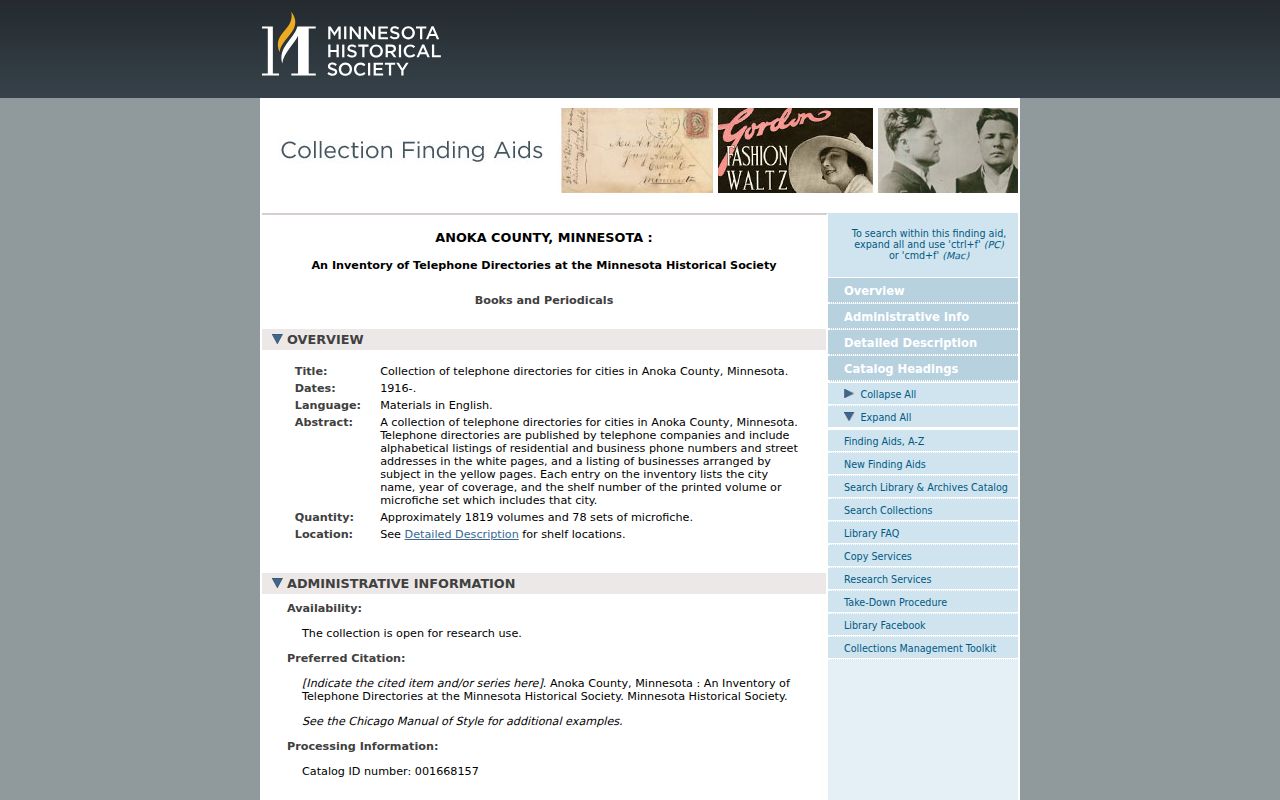
Shelf and fiche references beat a broad name search. They make the collection usable year by year, especially when a target date falls inside one of the documented gaps. That precision saves a wasted trip.
Note: Record the exact year and format beside every result so a later comparison never treats a telephone listing as undated evidence.
Andover Directory Research at ACHS
The Anoka County History Center at 2135 3rd Ave N in Anoka is the local companion to the MNHS shelves. Its reference collection covers Andover-area books, maps, newspapers, yearbooks, cemetery indexes, census material, and photographs. The newspaper holdings reach back to 1863. Union microfilm runs from 1865 to 2002, and Herald microfilm from 1885 to 1960. Naturalization material sits there too. So do selected church and civil records and land-ownership plat maps from 1888, 1914, and 1932. Together they give each entry its setting.
The human record runs deep here. The inventory counts more than 17,000 photographs, over 19,000 objects, and more than 250 oral-history interviews or transcripts. Newspaper announcements are indexed by date and last name. Thurston Mortuary records are indexed too. So is cemetery information. These sources can pin down an Andover time, place, or family relationship that a telephone book alone never reveals.
The Anoka County Historical Society research resources page describes those historical holdings and their research context.

Staff offer basic microfilm-reader training for Andover research. An initial search of about 15 minutes is free. Additional staff research runs $20 per hour, with photocopies at $0.25 per page plus postage. County-library holds, pickups, and returns are scheduled to end August 28, 2026. Confirm current Andover access arrangements before you travel.
Reading an Andover Directory Entry
Stick to the fields the Andover collection actually supports. The MNHS telephone inventory documents alphabetical white pages, residential and business classifications, telephone numbers, and street addresses where a subscriber was listed. It shows no sample Andover page. Spouse notations and ownership marks stay unconfirmed. Keeping that line clear keeps a familiar city-directory convention from hardening into an invented Andover fact.
| Printed name | Alphabetical white-page entry; search surname variants and initials. |
|---|---|
| Listing type | Residential or business white-page listing, or a Yellow Pages subject listing. |
| Street address | The subscriber address for the printed year, not proof of later residence. |
| Telephone number | Shown when listed; not every resident had a telephone subscription. |
| Household convention | Families are commonly listed by the head of household; minors are usually absent. |
- Criss-cross directory
- A directory arranged by street or address rather than name. No separate verified Andover criss-cross title or scanned section was located.
- Householder index
- An alphabetical listing centered on the household head. It can omit other people who lived at the address.
- Abbreviation key
- A legend explaining shortened terms or symbols. No local Andover key was verified, so do not infer one.
- White pages
- An alphabetical telephone listing that can pair a listed subscriber with an address and number for its printed year.
Photograph or transcribe the entire Andover line. Note the volume year, format, shelf, and page. Those details make a later correction possible when an initial, suffix, street direction, or listing category shifts between volumes.
Andover Directory Names Before Incorporation
Older records in this area rarely carry the modern city name. The land was Round Lake Township in 1857. It became Grow Township in 1860. The Village of Andover incorporated in 1972, and the City of Andover followed in 1974. A nineteenth-century person may therefore sit in a residents directory under Grow Township, Round Lake Township, or Anoka. The same person might also appear under a rural route or a station label rather than the current name. Searching a street directory or city directory from that era takes flexibility. Vary the place name as much as the surname.
The naming story also matters for directory research. A popular tale credits a train accident. The city history does not support it, since Andover was tied to the area before the railway arrived. The first train did reach Andover Station on July 4, 1899. That detail is interesting, yet the practical lesson is simpler. Try every historical place label before assuming an ancestor was missed.
- 1857: Round Lake Township organized in the present Andover area.
- 1860: the township name changed to Grow Township.
- 1972: the Village of Andover was established.
- 1974: Andover incorporated as a city.
- 1978: the first located Andover telephone-directory holding begins.
Tracing an Andover City Directory Household
A household trail works best when each record has a dated purpose. Start with the Andover address or PIN you already have. Then pick the nearest located telephone volume. Those volumes exist at times. Compare the printed Andover listing with the year before and the year after. Place the Andover directory result beside federal census years rather than instead of them. The 1950 census is the latest full release under the 72-year rule. ACHS keeps Anoka County census material covering 1857 through 1920. That rounds out the early end of a resident lookup.
- Choose the MNHS Andover volume nearest the target year and capture the name, initials, street suffix, telephone number, and shelf reference.
- Check an earlier and a later located volume, recording each spelling or address change rather than normalizing it away.
- Pair the dated entry with the relevant census, county tax card, or plat map for the same period.
- Search Anoka County Union or Herald notices for a move, marriage, death, civic event, or family reference tied to the name.
- For a deceased person, compare obituary, cemetery, probate, and deed evidence before connecting people across generations.
A household vanishing from the telephone books can mean many things. A move, a death, no subscription, or an unlisted number all look the same on the page. So does a missing local holding. An old directory lead sometimes needs modern confirmation. The Andover resident lookup route draws on current records instead. That keeps an old subscriber line from becoming a current-address claim.
Andover Directory Clues in Newspapers
Newspaper and archive material can supply the dated life event. An Andover telephone listing lacks it. ACHS indexes birth, death, and marriage announcements by date and last name. It also holds selected church and civil records, cemetery information, subject files, and yearbooks. Andover school yearbooks work well for a former classmate search. They remain historical sources, though, and may list minors or households selectively. No congregation publishes a membership roster here. Treat a church name as a place clue rather than a roster claim. That distinction keeps a residents directory conclusion honest.
- Use an obituary or cemetery index to test whether a surname disappears because of death.
- Use yearbooks and dated newspaper notices to place a person in an earlier Andover community.
- Use the 1888, 1914, and 1932 plat maps to connect an address to older owner geography.
- Use county census material for the township era before the telephone holdings begin.
Note: A newspaper address belongs to its publication date, so check it against an independent record before drawing any later conclusion.
Andover Directory Limits and Next Records
Andover publishes no official digitized directory volume. There is no local reverse-directory scan and no sample city directory page online. State the gap plainly and follow the physical-access chain. Inspect the MNHS finding aid. Contact the History Center with the Andover surname, township name, approximate years, and record group. Then use its on-site material or a research request. For older court and marriage work, MNHS holds Anoka district-court plaintiff and defendant indexes from 1858 through 1973, plus Anoka marriage books from 1858 through 1971, subject to the finding aids and access restrictions.
For a public local file that is not indexed online, the City Clerk is Andover's data-practices contact. A request under the Minnesota Government Data Practices Act, Minn. Stat. §13.03, should name the custodian, record type, address or name, date range, and preferred format. Public requesters generally need not state a reason. Searching, retrieval, copying, and redaction can still affect cost and timing. Andover historical work gains strength when these limits stay visible. A residents directory built on honest gaps beats one padded with assumed coverage.